

A/C Recharge vs. A/C Repair | What Does Your Car Need?
Your car’s A/C is blowing warm air on a 100-degree Houston afternoon. You search online and find two options: an AC recharge or an AC repair. Now you are wondering which one you actually need and whether you are about to overpay. This is one of the most common questions I hear from Houston drivers every summer.
Understanding the difference between these two services saves you real money and prevents costly mistakes. Let me break down exactly what each service is, what it costs, and which one your car needs. You will leave this guide knowing exactly what to tell your mechanic when you call.
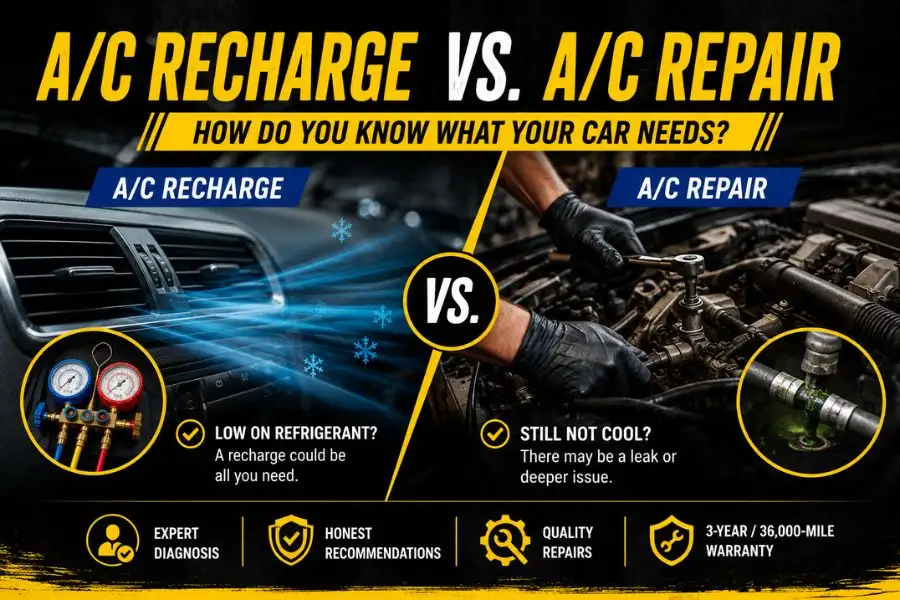
What Is an AC Recharge and What Does It Do
An AC recharge is the process of adding fresh refrigerant to your car’s air conditioning system. Refrigerant is the chemical that absorbs heat from inside your cabin and releases it outside. Over many years, small amounts of refrigerant can slowly escape through normal permeation in hoses and seals. This gradual loss reduces your AC system’s ability to cool the air inside your car.
A recharge simply adds the correct amount of refrigerant back to the system to restore proper cooling. The process takes about 45 minutes to one hour at a professional shop. A proper recharge involves recovering old refrigerant, pulling a vacuum, and adding fresh refrigerant by weight. Shops that skip the vacuum step are not doing a complete or proper job.
An AC recharge is the right service when your system has adequate refrigerant loss from normal permeation over years. It is not the right service when a leak is causing the refrigerant to escape faster than normal.
What Is an AC Repair and What Does It Include
An AC repair addresses a specific failed or damaged component within your air conditioning system. This service goes beyond adding refrigerant to find and fix what is actually causing the AC problem. AC repairs cover a wide range of possible fixes depending on which component has failed. Common AC repairs include leak detection and sealing, compressor replacement, condenser replacement, and evaporator service.
An AC repair always starts with a thorough diagnostic inspection of the entire system. Our technicians check pressures, test components, and use specialized equipment to find the exact problem.
The cost of an AC repair varies significantly based on which component needs attention. A simple O-ring seal replacement costs much less than a full compressor replacement on the same vehicle.
Knowing how long it takes to fix AC in your car helps you plan your service visit appropriately. More involved repairs like evaporator replacement take significantly longer than a simple refrigerant recharge service.
AC Recharge vs. AC Repair: Side-by-Side Comparison
This table summarizes the key differences between an AC recharge and a full AC repair to help you decide quickly.
| Feature | AC Recharge | AC Repair |
| What it does | Adds refrigerant to the system | Fixes the root cause of AC failure |
| Time required | 45 minutes to 1 hour | 1 hour to full day depending on repair |
| Average cost | $150 to $300 | $200 to $1,500 or more |
| Fixes a leak | No | Yes |
| Fixes compressor | No | Yes |
| Fixes condenser | No | Yes |
| How long results last | Temporary if leak exists | Long term when root cause is fixed |
| When to choose it | Gradual loss over many years | Any time a specific component has failed |
| Includes diagnostic | Sometimes | Always |
The Most Important Question: Do You Have a Leak?
Here is the single most important question that determines which service you actually need. Does your AC refrigerant have a leak, or has it simply reduced slightly over many years? A sealed AC system should hold refrigerant almost indefinitely under normal conditions. If your AC worked great two years ago and is now weak, a slow leak is likely the real cause.
Getting a recharge without fixing the underlying leak is like filling a tire with a nail in it. The refrigerant will escape again within weeks or months, and you will be back to square one. A professional leak detection test uses UV dye and electronic detectors to find where refrigerant is escaping. This diagnostic step is essential before deciding whether a recharge or a repair is the right approach.
Our trusted auto AC repair service always includes leak detection before recommending any specific service. We never recharge a leaking system and send you home with a temporary fix.
Signs You Need an AC Recharge Rather Than a Full Repair
An AC recharge is appropriate in specific situations that a good technician can identify quickly. Knowing these situations helps you understand when a recharge is genuinely the right answer for your car.
Your AC has been gradually getting weaker over three to five years of normal use. The system shows low refrigerant pressure, but no specific component has failed or is damaged.
Your car is newer and has never needed refrigerant service since leaving the dealership originally. The system has experienced only normal permeation loss that accumulates over many years of operation.
A pressure test confirms that refrigerant is low, but no leak source can be detected anywhere. In this case, a recharge with a UV dye addition makes sense to monitor for future leaks.
Even in these situations, a full vacuum and recharge process is required rather than simply topping off. Topping off without evacuation introduces moisture that damages your AC components over time.
Signs You Need an AC Repair Rather Than Just a Recharge
Several specific symptoms tell you clearly that your AC needs a repair, not just a simple recharge. Recognizing these signs prevents you from wasting money on a recharge that will not solve your problem.
Your AC stopped cooling suddenly rather than gradually losing effectiveness over time. A sudden loss typically means a component has failed rather than refrigerant slowly permeating out over years.
You can see oily residue around AC fittings, the compressor, or condenser indicating active refrigerant loss. This oily film is refrigerant oil that escapes with leaking refrigerant and leaves a visible mark.
You hear unusual noises from your AC compressor when the system is running. Grinding, rattling, or clicking from the compressor indicates internal damage requiring compressor replacement, not just recharging.
For a complete overview of compressor-related problems, read our guide on symptoms of a bad AC compressor in a car. Knowing these symptoms helps you accurately describe your problem when scheduling service.
You notice AC that only works sometimes or cuts in and out during normal operation. Intermittent AC function suggests an electrical fault, failing pressure switch, or compressor clutch problem needing repair.
Your AC was recharged recently and stopped working within weeks or months of that service. This pattern confirms a leak that was not addressed during the previous service visit.
If your AC has any of these symptoms, then its signs your car’s AC needs immediate repair before scheduling service. This guide helps you understand the urgency and communicate your problem clearly to technicians.
Why DIY AC Recharge Kits Are Not the Answer
You have probably seen those AC recharge cans at auto parts stores for $30 to $50. They seem like a great deal compared to professional service, but they create more problems than they solve.
These kits cannot measure or control exactly how much refrigerant enters your system. Overcharging your AC system damages the compressor and creates pressure imbalances that reduce cooling efficiency.
The cheap kits also cannot pull a proper vacuum before adding refrigerant to your system. This means moisture and air remain inside the system where they cause corrosion and reduce performance.
DIY kits cannot detect leaks and simply add refrigerant on top of an existing system problem. You spend $30, and two weeks later your AC stops working again from the same unrepaired leak.
Refrigerant handling also requires EPA Section 609 certification for a very important reason. Improper refrigerant release is harmful to the environment and illegal under federal regulations that apply to everyone.
What to Expect During a Professional AC Diagnosis at Wise Care Care
Our AC diagnosis starts with a complete system pressure test using professional manifold gauge equipment. This test immediately reveals whether your system has proper refrigerant levels or is critically low.
We inspect every accessible AC component visually for signs of damage, corrosion, or leakage. UV light inspection finds refrigerant dye traces that confirm exactly where any leaks are located.
We test compressor clutch engagement, fan operation, and electrical connections throughout the AC circuit. This comprehensive approach ensures we find every problem contributing to your AC’s poor performance.
After diagnosis, we give you a clear written estimate showing exactly what service your car needs. We explain whether a recharge, a specific repair, or both services are the right recommendation for your situation.
We never recommend a recharge on a leaking system just to provide a quick temporary fix. Our reputation depends on giving you honest advice that solves your problem completely and permanently.
According to the Environmental Protection Agency, all automotive refrigerant service must be performed using certified recovery equipment by trained technicians. We follow all EPA Section 608 regulations during every AC service we perform.
How Much Do AC Recharge and Repair Cost in Houston
Understanding typical costs helps you budget appropriately and recognize fair pricing when you see it. Costs vary based on your vehicle type, which components need service, and which refrigerant type your car requires.
A professional AC recharge including recovery, vacuum, and proper recharge typically costs between $150 and $300. This price should always include the full process, not just adding refrigerant without evacuation.
Leak detection and repair costs vary significantly based on where the leak is located in the system. A simple O-ring or fitting seal replacement costs $100 to $250, while condenser replacement runs $400 to $900.
Compressor replacement is the most expensive AC repair, typically ranging from $800 to $1,500 installed. Evaporator replacement is similarly expensive due to the extensive dashboard disassembly required for access.
Getting the right diagnosis first prevents you from paying for a recharge that does not fix your actual problem. A $150 diagnostic fee can save you from a $250 recharge that fails within weeks due to an unaddressed leak.
Frequently Asked Questions About AC Recharge vs AC Repair
How Do I Know If I Need an AC Recharge or a Full AC Repair?
If your AC gradually weakened over three to five years without sudden failure, a recharge may be sufficient. If your AC stopped working suddenly or failed again shortly after a previous recharge, you need a repair.
Never let a shop recharge your system without first checking for leaks and testing component function. A recharge on a leaking system is money wasted since the refrigerant will escape again quickly.
How Long Does an AC Recharge Last in Houston?
A proper AC recharge on a system without leaks can last many years under normal operating conditions. Refrigerant does not get consumed during operation and should remain in a sealed system indefinitely.
If your recharge only lasts a few months before warm air returns, you have an unrepaired leak. The recharge did not fail because of poor service but because the underlying leak was never addressed.
Houston’s extreme operating conditions mean more stress on seals and connections than in cooler climates. Annual AC inspections help catch new leaks before they cause problems during our hottest months.
Can I Drive My Car With Low AC Refrigerant Without Causing Damage?
Yes, driving with low refrigerant is generally safe for your safety but potentially harmful to your compressor. The AC compressor relies on refrigerant for both cooling and lubrication during normal operation.
Running a compressor with severely low refrigerant causes it to overheat and potentially seize from inadequate lubrication. This turns a simple recharge situation into an expensive compressor replacement costing $800 or more.
Why Did My AC Stop Working Right After Getting a Recharge?
This situation almost always means the recharge was performed on a system with an active refrigerant leak. The new refrigerant escaped through the same unrepaired leak shortly after the service was completed.
A reputable shop should always perform leak detection before recharging your system to prevent this outcome. If a shop skipped this step, they did not provide a complete or professional AC service.
Is an AC Recharge or Repair Covered Under My Car Warranty?
New vehicle factory warranties typically cover AC components that fail due to defects in materials or workmanship. Normal refrigerant recharging is generally considered a maintenance service not covered under standard warranties.
Extended warranties vary significantly in what AC services and repairs they include in their coverage. Read your specific warranty documentation carefully or call your warranty provider to confirm AC coverage.
Aftermarket extended warranties often cover compressor replacement but may exclude refrigerant recharge services. Always confirm coverage before authorizing any AC work if you plan to use your warranty for payment.