

What Are the Symptoms of a Bad PCV Valve?
Your engine starts running rough, and you cannot figure out what is causing the problem. A bad PCV valve might be the small culprit behind several frustrating engine symptoms you are experiencing. This tiny component causes a surprising range of symptoms that most drivers never connect to one small part.
The PCV valve is one of the most overlooked components during routine maintenance and inspection visits. Yet when it fails, it affects your engine oil, fuel economy, emissions, and overall engine health significantly. Let me explain every symptom a bad PCV valve causes and what you should do when you notice them.
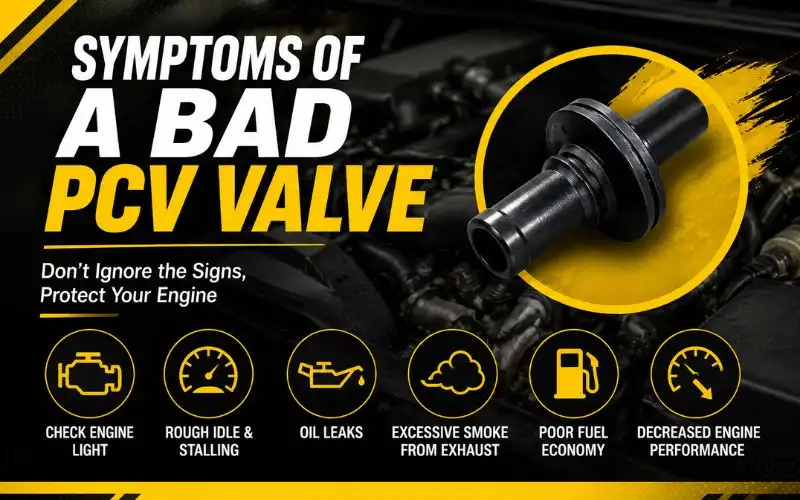
Why a Failing PCV Valve Creates So Many Different Symptoms
If you’re wondering what a PCV valve is, it’s a small engine part that controls crankcase pressure and sends harmful gases back into the engine to be burned. When it fails, it can fail in two distinctly different ways, each causing different sets of symptoms. Understanding both failure modes helps you identify which specific problem your engine is experiencing.
A stuck closed PCV valve traps gases and pressure inside the crankcase with nowhere to escape. This trapped pressure builds until it forces oil past every seal and gasket in the engine.
A stuck open PCV valve allows too much airflow into the intake manifold at the wrong time. This excess unmetered air upsets the precise air-fuel mixture your engine management system needs to function.
Both failure modes are harmful, but they create noticeably different symptom profiles during normal driving. Learning to recognize each type helps you communicate the problem accurately when calling our shop.
Top Symptoms of a Bad PCV Valve
1. Rough Idle That Comes and Goes Unpredictably
A rough idle is one of the most common and frustrating symptoms of a failing PCV valve. The valve’s job includes maintaining proper vacuum balance in your intake manifold at idle speeds.
When it sticks open or develops a leak, uncontrolled air enters the intake and disrupts the mixture. Your engine stumbles and misfires at idle because the air-fuel ratio is no longer properly balanced.
This rough idle is often worse when the engine is cold and has not reached operating temperature. The symptom may seem to improve after driving for a while as the engine fully warms up.
Houston drivers dealing with stop-and-go traffic notice this rough idle more since they spend significant time at idle. Red lights, school zones, and gridlock on I-10 expose this problem more than steady highway driving would.
The rough idle from a bad PCV valve is easy to confuse with spark plug or fuel injector problems. Proper diagnosis is essential to avoid paying for unneeded parts that do not solve the actual problem.
Our auto tune-up service includes PCV valve inspection as a standard component of every engine evaluation. We accurately identify whether the PCV valve or other components are causing your idle quality problems.
2. Oil Leaks From Gaskets and Seals Around the Engine
Finding oil puddles under your car or noticing oily residue around engine components is a concerning symptom. A stuck-closed PCV valve is one of the most common causes of engine oil leaks many drivers experience.
When the valve cannot open, blow-by gases have no escape route from the crankcase during operation. Pressure builds rapidly inside the engine and pushes against every seal, gasket, and O-ring it can find.
The weakest seals fail first under this constant pressure, including your valve cover gaskets and rear main seal. Replacing these gaskets without addressing the PCV valve causes the new gaskets to leak again very quickly.
Many Houston drivers pay for gasket repairs multiple times without realizing the PCV valve is the real culprit. The oil keeps returning because the pressure source driving the leaks was never actually fixed properly.
Oil leaking from your front crankshaft seal is another common result of excessive crankcase pressure buildup. This seal sits near the front pulley and can fail from sustained pressure created by a stuck closed valve.
Always have the PCV system inspected whenever oil leaks are diagnosed on your engine during any service visit. Addressing the root cause prevents the same leaks from recurring after expensive gasket replacement service.
3. Increased Engine Oil Consumption Between Changes
You check your oil between changes and find the level has dropped significantly more than normal. A stuck-open PCV valve draws oil mist from the crankcase directly into the intake manifold continuously.
This oil mist enters the combustion chamber where it burns alongside the regular fuel and air mixture. The burning oil reduces your oil level without leaving any visible puddles on the ground beneath your car.
Many drivers are confused by oil consumption that occurs without any visible leak anywhere on the engine. The PCV system is the first place an experienced technician checks when this specific symptom appears.
Houston’s extreme summer heat accelerates PCV valve deterioration, making this symptom more common here than in cooler climates. Heat causes the valve’s internal components to harden and lose the flexibility needed for proper operation.
Unchecked oil consumption from a bad PCV valve eventually causes low oil level warnings during normal driving. Running low on engine oil in Houston’s heat creates a dangerous lubrication situation for critical engine components.
Check your oil level monthly and note whether it drops faster than expected between your regular oil changes. Unusual consumption that started recently often points directly to a PCV valve that needs immediate replacement.
4. Black Or Gray Smoke Coming From Your Exhaust Pipe
Seeing black smoke coming from your exhaust pipe is a specific symptom worth paying close attention to. This colored smoke indicates engine oil is being burned inside the combustion chamber during normal operation.
A stuck-open PCV valve draws oil mist into the intake manifold that then enters each cylinder for burning. The burning oil produces that distinctive blue or grayish tint that differs from normal exhaust appearance.
You may notice this smoke most clearly during engine startup in the morning after the car has sat overnight. It may reduce or disappear once the engine fully warms up and the PCV valve begins functioning differently.
Blue smoke that appears during acceleration points toward oil being drawn through a stuck-open valve actively. The increased intake vacuum during acceleration pulls more oil mist than at idle, creating visible smoke during hard driving.
5. Check Engine Light With Fuel Mixture Related Codes
A failing PCV valve frequently triggers the check engine light through its effect on the air-fuel mixture. Modern engine management systems monitor oxygen levels and fuel trim values with great precision during operation.
A stuck-open PCV valve introduces unmetered air into the intake that the mass airflow sensor never measured. The computer receives air that was not counted and cannot properly adjust fuel delivery to compensate.
This unmeasured air creates a lean condition where there is more air than the computer expected for the fuel amount. The oxygen sensors in the exhaust detect this lean condition and send signals requesting more fuel.
Common fault codes triggered by PCV-related lean conditions include P0171 for bank one lean and P0174 for bank two lean. These codes appear frequently when PCV valves develop significant leaks or stick in the open position.
The check engine light from a PCV-related code will not clear permanently until the valve is actually replaced. Clearing the code with a scan tool without fixing the valve simply causes the light to return within days.
Never ignore a check engine light hoping it resolves itself, since the underlying condition continues causing damage. Our engine diagnostics service identifies whether PCV problems are behind your check engine light quickly and accurately.
6. Sludge Buildup Inside the Engine and on the Oil Cap
Removing your oil filler cap and looking inside reveals a lot about your PCV system’s health. Healthy engines have clean oil and minimal sludge deposits visible through the oil filler opening on top.
A failing PCV valve that cannot properly ventilate the crankcase allows moisture and gases to contaminate your oil. Over time this contamination causes oil to break down into a thick brownish or grayish sludge.
You can see this sludge as a thick coating on the underside of your oil filler cap in severe cases. This finding confirms the PCV system has been compromised for long enough for significant contamination to accumulate inside.
Engine sludge clogs narrow oil passages that feed critical components like camshaft bearings and hydraulic lifters. Starved of proper oil flow, these expensive components wear rapidly and eventually fail completely from inadequate lubrication.
Sludge found during a routine oil change or inspection is a serious warning sign requiring immediate PCV valve replacement. Continuing to drive with a sludged engine accelerates internal damage that can total a vehicle with high repair costs.
Houston’s heat accelerates sludge formation when PCV ventilation is compromised since high temperatures break down oil faster. The combination of heat and poor ventilation is particularly destructive to engine oil quality and engine internal health.
7. Hissing or Whistling Noise From the Engine Compartment
Unusual sounds under your hood are worth checking. A hissing or whistling sound from the PCV system can point to a vacuum issue. A hissing noise when braking may also be a sign of a vacuum-related problem that needs professional inspection
When PCV hoses crack, collapse, or disconnect from their fittings, they create vacuum leak noises during operation. These hoses route between the valve cover and the intake manifold and are exposed to constant heat and vibration.
The hissing sound is most prominent at idle when intake vacuum is highest, and airflow through any leak is maximum. The noise may decrease or change character as engine speed increases during acceleration events.
Run your hand carefully near PCV hoses while the engine runs to feel for air movement indicating a hissing leak. Never touch hot engine components, but feeling near hose connections often helps locate vacuum leak sources quickly.
Cracked PCV hoses create the same airflow problems as a failed valve itself since both disrupt crankcase ventilation. Always inspect all connected hoses during PCV valve replacement to ensure a complete and effective repair is performed.
A hissing sound from the PCV system is sometimes confused with noises from other vacuum lines in the engine. Professional diagnosis with a smoke machine definitively identifies all vacuum leak locations quickly without guesswork.
8. Reduced Fuel Economy Over Recent Weeks or Months
Noticing your fuel economy dropping without any change in driving habits or conditions is a meaningful clue. A bad PCV valve affects fuel economy through the lean fuel trim correction your engine computer continuously performs.
When the valve creates a vacuum leak, the computer adds extra fuel, attempting to compensate for the lean condition. This constant enrichment uses more fuel than the engine actually needs for the current driving conditions.
Houston drivers covering long commutes to downtown or the Galleria notice fuel economy changes more dramatically than those with shorter drives. A 10 to 15% reduction in miles per gallon represents real money spent at Houston’s gas stations.
The fuel economy decline from a PCV valve problem develops gradually, so many drivers initially miss the connection. Tracking your fuel economy over several fill-ups reveals the trend that points toward investigating the PCV system.
Fixing the PCV valve often restores fuel economy alongside eliminating the other symptoms it was causing. Combined with fresh spark plugs from our tune-up service, fuel economy improvements after PCV replacement are often very noticeable.
9. Engine Misfires During Acceleration or at High RPM
Your engine misfires create a stumbling or hesitation sensation during normal acceleration from a stopped position. A bad PCV valve contributes to misfires by disrupting the precise air-fuel ratio your engine requires.
When the valve sticks open during acceleration, excessive air enters and creates a lean mixture in the cylinders. Lean mixtures do not ignite as reliably as properly proportioned mixtures, causing incomplete combustion events called misfires.
These misfires feel like a brief loss of power or stumble that happens inconsistently during hard acceleration. They may feel worse under heavy load conditions like merging onto Houston freeways from a stopped position.
Prolonged misfires from a bad PCV valve cause secondary damage to your catalytic converter over time. The unburned fuel and gases from misfires overheat the catalytic converter and damage its internal structure permanently.
Catalytic converter replacement costs $800 to $2,000, making it one of the more expensive results of PCV neglect. A $30 PCV valve replacement prevents this expensive secondary damage when addressed promptly at first symptoms.
10. Oil on the Air Filter or Inside the Air Intake System
Inspect your engine air filter for any oily residue or contamination during routine maintenance service visits. Finding oil on your air filter or inside the air intake hose is a specific and reliable symptom.
A stuck-open PCV valve draws excessive oil mist from the crankcase and routes it into the intake system. Some of this oil deposits on the air filter element and coats the inside of the intake hoses.
A lightly oily film inside the intake is somewhat normal due to how the PCV system works by design. However, heavy oil coating or a noticeably saturated air filter indicates the PCV valve is drawing far too much oil.
An oil-contaminated air filter cannot flow air efficiently through its filter media even when relatively new. This restricted airflow further disrupts the air-fuel mixture and compounds the performance problems the bad valve already created.
Houston’s already challenging air quality with pollen and dust makes a clean, unrestricted air filter even more important. A contaminated filter combined with a bad PCV valve creates compounding airflow and mixture problems simultaneously.
When to Suspect the PCV Valve vs. Other Components?
Multiple symptoms appearing together most strongly suggest the PCV valve as the common cause. One symptom alone might point elsewhere, but several appearing simultaneously make PCV involvement very likely.
If you have rough idle alongside oil consumption and a check engine light together, suspect the PCV valve immediately. This three-symptom combination pointing to one small component is a classic PCV valve failure presentation.
Oil leaks combined with pressure-related gasket failures without any obvious external damage also strongly suggest PCV involvement. When gaskets fail prematurely on an otherwise well-maintained engine, crankcase pressure is the most frequent explanation.
Finding engine sludge during an oil change on a vehicle that receives regular oil changes is another strong indicator. A properly ventilated crankcase should not produce significant sludge between regular oil changes on any engine.
Professional diagnosis confirms whether the PCV valve is the culprit or whether other components share the blame. We check the valve, all hoses, the breather filter, and related components during a complete PCV system evaluation.
Trust Wise Car Care for PCV System Service in Houston
Our ASE-certified technicians understand exactly how PCV valve failures manifest in Houston’s specific climate conditions. We diagnose these problems quickly using professional testing equipment rather than guessing at symptoms alone.
We stock PCV valves and replacement hoses for most common Houston-area vehicle makes and models. Same-day service is available for most PCV-related repairs since parts are readily available at our shop.
Every PCV valve replacement includes a complete inspection of all connected hoses and the breather filter system. This thorough approach ensures your entire crankcase ventilation system functions correctly after service is completed.
All engine maintenance services we perform are covered by our 36-month or 36,000-mile parts and labor warranty. This warranty gives you complete confidence in every component we install and every service we perform.
We’re located at 6259 N Eldridge Parkway, Houston, TX 77041, and proudly serve drivers throughout Houston and nearby areas. We are open Monday through Friday from 8:00 AM to 6:00 PM for all engine maintenance services. Saturday appointments are available from 8:00 AM to 4:00 PM for weekend scheduling convenience.