

Wheel Bearing Noise | Causes, Symptoms & What to Do
You hear a strange humming or grinding sound while driving on the highway today. It seems to change with your speed, and you have no idea what is causing it.
That sound is very likely coming from a worn wheel bearing inside one of your wheels. I have been diagnosing wheel bearing problems for Houston drivers for over fifteen years at our shop.
Wheel bearings are small but critical components that allow your wheels to spin smoothly while supporting the vehicle’s weight. When they fail, the noise they create is unmistakable once you know what to listen for.
Ignoring wheel bearing noise is never the right decision since these components can fail without much warning. Let me explain every cause, symptom, and solution so you know exactly what to do right now.
If you’re noticing a humming, growling, or rumbling wheel bearing noise and you live in Houston, don’t ignore it. Bring your vehicle to Wise Car Care for a proper inspection. Our experienced technicians can find the source of the noise and help you get back on the road safely.
What Are Wheel Bearings and What Do They Do?
Wheel bearings are precision-engineered sets of steel balls or rollers contained inside a metal ring called a race. They sit in your wheel hub and let each wheel spin freely with minimal friction.
Every wheel on your vehicle has its own wheel bearing supporting the weight of the corner it serves. These bearings handle both the vehicle’s weight and the lateral forces during cornering.
Modern vehicles use sealed hub bearing assemblies that combine the bearing with the wheel hub into one unit. These sealed units cannot be repacked with grease and must be replaced completely when they fail.
Wheel bearings are designed to last between 85,000 and 100,000 miles under normal driving conditions. Houston’s rough roads, floodwater exposure, and extreme heat can shorten this lifespan considerably in our climate.
What Does a Bad Wheel Bearing Sound Like?
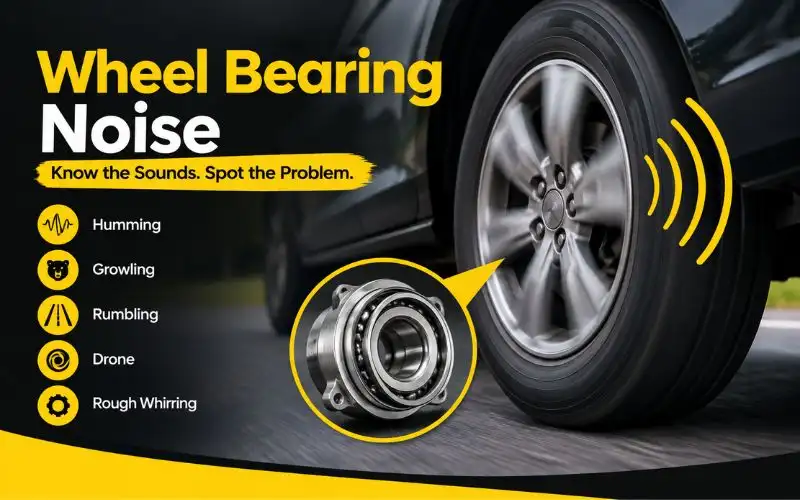
A bad wheel bearing may sound like a humming, growling, rumbling, or rough whirring noise. The sound usually gets louder as your driving speed increases, but it can vary depending on the vehicle and bearing condition.
Grinding or Growling Noise
One of the first signs of a bad wheel bearing is a grinding, growling, or humming sound while you drive. The noise usually gets louder as your speed increases. You may notice it most when driving on the highway or at a steady speed.
Noise Changes When Turning
A bad wheel bearing can sound different when you make a gentle turn. If the noise gets louder or quieter when you turn left or right, it could point to a worn bearing. This happens because the vehicle’s weight shifts from one side to the other.
Humming Sound at Higher Speeds
A worn bearing may start with a soft humming sound that you only notice at higher speeds. Many drivers mistake it for tire or road noise at first. Over time, the humming can become louder and easier to hear during normal driving.
Rumble or Vibrating Sound
Some people describe wheel bearing noise as sounding like they are driving over rumble strips. Others notice a steady buzzing or rough humming sound. If you hear a strange noise that continues while driving, it is worth having the wheel and bearing checked.
Noise Gets Louder Over Time
Wheel bearing noise usually becomes more noticeable as the bearing wears out. It might start as a faint hum and gradually turn into a louder growling or grinding sound. Getting it checked early can help prevent further damage and keep your vehicle safe on the road.
Common Symptoms of a Bad Wheel Bearing
Wheel bearing problems create multiple symptoms beyond just noise that you can use to confirm your suspicion. Recognizing these additional symptoms helps you make an accurate diagnosis before visiting a professional.
Noise-related symptoms:
- Grinding or growling sound that increases with vehicle speed
- Humming noise that changes when turning or changing lanes
- Clicking or snapping sound during low-speed turns in parking lots
- Sound that seems to come from one specific corner of the vehicle
- Service or replace faulty brake calipers for consistent brake engagement.
- Noise that worsens on certain road surfaces but never disappears completely
Handling and steering symptoms:
- Steering wheel vibration that increases with speed or during turns
- Vehicle pulling to one side even on smooth flat roads
- Loose or imprecise steering feel that was not present before
- Shuddering or shaking felt through the floor during acceleration
Physical symptoms visible during inspection:
- Wheel that rocks side to side when lifted off the ground
- Uneven tire wear on the affected corner
- Excessive heat coming from one specific wheel after driving
- Grease stains around the wheel hub area from seal failure
If your steering wheel is also shaking alongside unusual noise, read our guide on why your steering wheel shakes for related causes. Multiple symptoms appearing together always indicate a more urgent repair situation.
What Causes Wheel Bearing Failure?
Understanding what damages wheel bearings helps you prevent premature failures and recognize contributing factors. Several specific causes are especially common for Houston area drivers.
Normal Wear and Age
The most common cause of wheel bearing failure is simply normal wear accumulated over many years of driving. These components operate under constant load with millions of rotation cycles throughout their service life.
The steel balls and races inside the bearing gradually develop microscopic surface fatigue over time. This surface fatigue eventually causes the roughness and play that create the characteristic grinding noise you hear.
Most wheel bearings reach end of life somewhere between 85,000 and 100,000 miles with normal driving conditions. Houston’s specific conditions often bring failures at the lower end of this range for local drivers.
Pothole and Impact Damage
Houston’s roads are notorious for potholes, rough surfaces, and unexpected road damage throughout the city. Hitting a deep pothole at speed sends a shock load through the wheel bearing far beyond its design limits.
This impact load can crack internal bearing components, damage the outer race, or contaminate the sealed grease. Even when the damage is not immediately catastrophic, the impact accelerates wear that shortens bearing life.
A wheel bearing that begins making noise shortly after hitting a significant pothole has suffered impact damage from that event. Our suspension repair service inspects wheel bearings after any significant pothole impact at your request.
Water and Flood Exposure
Houston is no stranger to flooding, and our vehicles frequently encounter deep standing water during heavy rain events. Water intrusion past a bearing seal washes out the protective grease inside the sealed unit.
Once the grease is displaced by water, metal-to-metal contact occurs inside the bearing during normal operation. This contact accelerates wear dramatically and causes bearing failure much sooner than normal age-related wear.
Even driving through consistently deep puddles over time slowly degrades wheel bearing seals through repeated exposure. This is why Houston vehicles sometimes experience wheel bearing failures at lower mileages than national averages.
Incorrect Wheel Installation
Improperly torqued wheel lug nuts create vibration and uneven loading that damages wheel bearings prematurely. Over-torqued lug nuts distort the bearing hub, while under-torqued nuts allow micro-movement that creates accelerated wear.
Any shop that removes and reinstalls wheels must torque lug nuts to manufacturer specifications using a calibrated torque wrench. Always verify that wheels were properly torqued after any tire service or wheel removal work.
Worn or Incorrect Tires
Severely worn or mismatched tires create vibration patterns that stress wheel bearings beyond their design loads. Uneven tire wear from poor alignment transfers irregular forces into the bearing with every wheel rotation.
Keeping your tires properly inflated, rotated, and aligned protects wheel bearings from premature wear. Regular tire inspections during routine maintenance catch developing wear patterns before they damage bearing components significantly.
How to Test for a Bad Wheel Bearing?
You can perform a simple test that helps identify which wheel bearing is failing before visiting a professional. This test requires a safe, empty road or large parking lot with no other vehicles present.
Drive at approximately 40 to 50 miles per hour on a straight, flat surface while listening carefully. Then gently and safely swerve slightly to the left and then to the right and note how the noise changes.
If the noise gets louder when you swerve left, the failing bearing is likely on the right side. If the noise increases when you swerve right, the left-side bearing is probably the faulty one.
This works because steering loads weight onto the bearing on the outside of each turn during the maneuver. A failing bearing produces more noise when it carries more load from the weight transfer.
Professional inspection includes lifting the vehicle and physically testing each wheel for play and roughness. A technician grabs the wheel at the top and bottom and rocks it to check for any looseness in the bearing.
Is It Safe to Drive With a Bad Wheel Bearing?
The answer depends entirely on how far advanced the bearing failure is when you first notice the noise. Early-stage bearing noise is not immediately dangerous, but the situation changes as deterioration progresses.
A severely worn wheel bearing can fail while driving, causing the wheel to seize or even separate from the vehicle. Complete wheel-bearing failure at highway speed instantly causes a catastrophic loss of vehicle control.
Watch for these signs that indicate your bearing has reached a dangerous stage requiring immediate attention:
- The grinding noise is now very loud at all driving speeds, including low speeds in parking lots
- You feel vibration or looseness in the steering wheel during normal highway driving
- The affected wheel feels hot to the touch after a normal length drive
- The vehicle pulls significantly toward one side without any steering input from you
- The noise has changed from a hum to a harsh grinding or metallic growling sound
If any of these conditions exist, stop driving and have your vehicle towed to a professional shop immediately. Continuing to drive risks complete wheel separation that can cause a serious accident without any warning.
According to the National Highway Traffic Safety Administration, wheel end-related failures are among the most serious safety issues identified during commercial vehicle inspections. The same risk applies to passenger vehicles with severely worn wheel bearings in any driving situation.
How Much Does Wheel Bearing Replacement Cost?
Wheel bearing replacement cost varies based on your vehicle type, which corner needs service, and your shop’s labor rates. Understanding typical costs helps you budget appropriately and recognize fair pricing from a reputable shop.
Front wheel bearing replacement typically costs between $250 and $500 per side for most standard passenger vehicles. Rear wheel bearing replacement is often slightly less expensive at $200 to $450 per side for similar vehicles.
Trucks, SUVs, and European luxury vehicles cost more due to higher parts prices and longer labor times. Some European vehicles require special tools and more labor time that significantly increases the total repair cost.
The hub bearing assembly is the most expensive component in this repair, typically costing $80 to $200 for most vehicles. Labor adds $150 to $300 depending on how difficult the bearing is to access on your specific vehicle. Always ask for a written estimate that breaks down parts and labor before authorizing any wheel bearing replacement.
Bad Wheel Bearing vs. Tire Noise
Many drivers confuse wheel bearing noise with normal tire noise since both sounds come from the wheel area. Knowing the differences saves you from replacing tires when the wheel bearing is actually the real problem.
Wheel bearing noise characteristics:
- Changes predictably when you swerve left or right at speed
- Stays consistent on different road surfaces during the same drive
- Gets progressively louder over weeks and months as wear increases
- Does not change when tire pressure is adjusted to correct specification
- Often accompanied by steering vibration or loose steering feel
Tire noise characteristics:
- Often changes significantly between smooth asphalt and rougher road surfaces
- Stays relatively consistent during gradual left and right steering movements
- Typically does not cause steering wheel vibration at normal highway speeds
- Usually develops patterns related to specific tire wear issues visible on inspection
- May improve or worsen when tire pressure is checked and corrected
If you are unsure whether your noise is a bearing or tire issue, have both inspected at the same visit. Our technicians check bearing condition and tire wear together to identify the true source of your noise accurately.
Related suspension noises sometimes accompany wheel bearing problems, making diagnosis more complex than expected. Our guide on suspension squeaking over bumps explains how to identify different suspension noises from each other.
What to Do When You Suspect a Wheel Bearing Problem?
The most important first step is scheduling a professional inspection as soon as you notice unusual wheel noise. Do not wait to see if the noise gets worse since bearing failures can accelerate rapidly once they begin.
Avoid highway driving at high speeds if your bearing noise is already loud and clearly established. Slower speeds reduce the load on the failing bearing and decrease the risk of sudden complete failure.
Note exactly when the noise occurs, at what speed, and whether it changes during turning maneuvers. This information helps our technicians focus their inspection immediately on the most likely cause and location.
Check your other suspension components at the same time since wheel bearing failures often coincide with related worn parts. Our technicians inspect ball joints, tie rod ends, and hub hardware alongside every wheel bearing replacement.
A wheel alignment check after wheel bearing replacement ensures your vehicle tracks straight and tires wear evenly. Bearing replacement can sometimes affect alignment angles slightly depending on your vehicle’s specific design.
Preventing Wheel Bearing Failure in Houston
Regular inspections during routine maintenance catch developing wheel bearing wear before it becomes a noisy emergency. Our team checks all four wheel bearings during comprehensive suspension inspections at every service visit.
Avoid driving through deep standing water whenever Houston flooding allows you a safer alternative route. Choosing alternate routes during heavy rain events protects wheel bearing seals from water contamination.
Address pothole impacts by having suspension and wheel bearings checked after any significant road impact. Early detection of impact damage prevents progressive wear from developing into complete bearing failure later.
Maintain proper wheel alignment to prevent the irregular loading patterns that accelerate wheel bearing wear. Our wheel alignment service ensures your wheels are positioned correctly to distribute loads evenly across all four bearings.
Trust Wise Car Care for Wheel Bearing Service in Houston
Our ASE-certified technicians diagnose wheel bearing problems quickly and accurately using professional inspection techniques. We identify the exact failed bearing and check all related suspension components during every service visit.
We use quality wheel hub bearing assemblies that meet or exceed your manufacturer’s specifications for your vehicle. Quality parts installed correctly by experienced technicians provide reliable long-term performance on Houston’s demanding roads.
Every wheel bearing replacement includes inspection of the hub, knuckle, and all related fasteners and components. This thorough approach ensures the new bearing is installed correctly the first time without any shortcuts.
All suspension and wheel bearing repairs are covered by our 36-month or 36,000-mile parts and labor warranty. This warranty gives you complete confidence that your repair will hold up through many miles of Houston driving.