

The Simple Answer: Yes, Bad Alignment Hurts Your Gas Mileage
Misaligned wheels create rolling resistance that your engine must constantly overcome to move the car forward. This extra resistance forces your engine to burn more fuel than it normally would need to. Think of it like walking with your feet pointed in opposite directions at the same time. Your body works much harder to cover the same distance compared to walking with feet pointed straight.
Your tires behave the same way when they are not properly aligned to the road surface. They fight against each other and against the road instead of rolling cleanly and efficiently forward. Studies suggest that improper wheel alignment can reduce fuel economy by as much as 10 percent. For Houston drivers covering long commutes on I-10 and 290, this fuel waste adds up very quickly over time.
How Wheel Alignment Works and Why It Matters for Fuel Economy
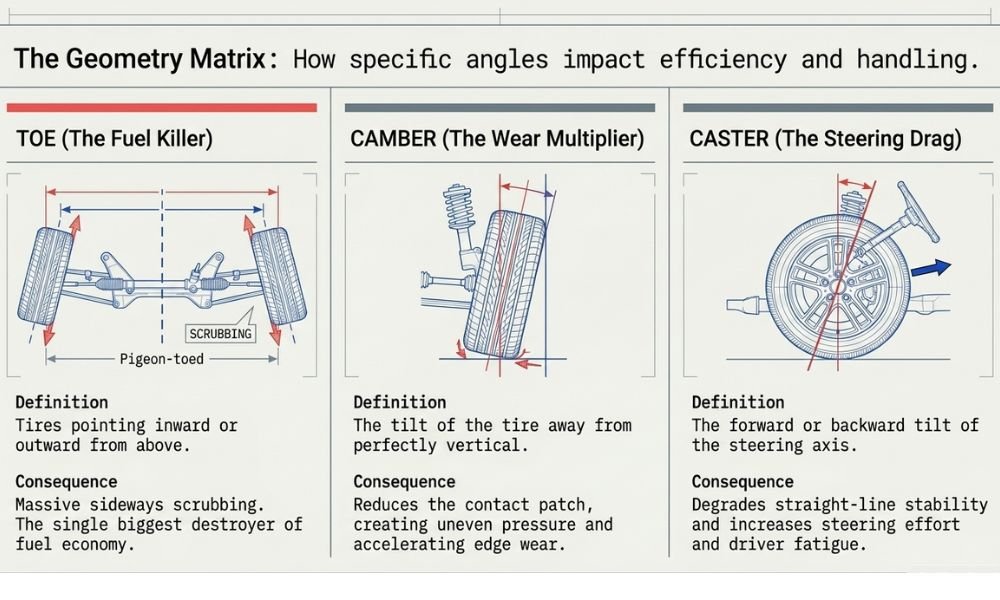
Wheel alignment refers to the precise angle at which your tires contact the road surface. These angles are carefully set by manufacturers to minimize friction, promote even tire wear, and improve handling. The three main alignment angles are camber, toe, and caster, and each affects your fuel economy differently. When any of these angles falls outside the manufacturer’s specification, problems follow quickly.
Toe alignment has the most direct impact on fuel efficiency of all three alignment settings. Toe refers to whether your tires point slightly inward or outward when viewed from directly above the car. Even a few millimeters of incorrect toe creates significant sideways scrubbing across the road surface constantly. This sideways friction forces your engine to work harder to maintain any given speed.
Camber alignment affects how much of your tire’s surface contacts the road at any moment. Incorrect camber reduces the contact patch and creates uneven pressure that increases rolling resistance. Caster alignment affects straight-line stability and steering effort more than fuel economy directly. However, severe caster problems still create additional steering resistance that the engine must compensate for.
How Much Fuel Does Bad Alignment Actually Waste
The fuel penalty from misaligned wheels is easy to underestimate until you look at the actual numbers. Even a modest 5% reduction in fuel economy costs real money over the course of a full year. If you currently get 25 miles per gallon and drive 15,000 miles annually, consider this calculation carefully. A 10 percent reduction in fuel economy costs you roughly 60 extra gallons of gas per year.
At current Houston gas prices, that easily translates to $180 to $240 wasted every single year. A professional wheel alignment service typically costs between $75 and $150 and solves the problem immediately. The math is straightforward, and the savings are real for every Houston driver who addresses alignment. You recover the alignment cost in fuel savings within just a few months of having the service done.
Signs That Misalignment Is Hurting Your Fuel Economy Right Now
Your car often gives clear warning signs when alignment problems are affecting your fuel consumption. Learning to recognize these signs helps you act before the waste becomes too significant. Noticing your fuel gauge dropping faster than usual without any obvious change in driving habits is a key sign. If you are filling up more often than before, alignment deserves investigation alongside other possible causes.
Uneven tire wear is one of the most reliable signs of an alignment problem affecting your car. Check your tires regularly for wear that is heavier on one edge than across the entire tread width. For a complete list of what to look for, read our detailed guide on symptoms of bad wheel alignment and how they affect your driving. Catching alignment problems early saves both fuel and expensive premature tire replacement costs.
A steering wheel that pulls to the left or right on a straight flat road is another clear sign. Your engine burns extra fuel constantly correcting this pull even when you are just driving in a straight line. If your steering wheel shakes or vibrates, alignment may be contributing to the problem alongside other factors. Read our guide on why your steering wheel shakes for a full explanation of related causes.
A steering wheel that sits crooked when you are driving straight ahead is also a strong indicator. This visual cue tells you something in your alignment geometry is no longer set to specification.
The Rolling Resistance Connection: Why Your Engine Burns More Fuel
Rolling resistance is the force your engine must overcome to keep your tires moving forward. Properly aligned tires have minimal rolling resistance since they roll cleanly in the direction of travel. Misaligned tires create sideways friction called scrubbing that dramatically increases rolling resistance. Your engine senses this extra resistance and compensates by burning more fuel to maintain your speed.
This happens continuously at every speed from parking lot crawling to full highway driving. The engine never gets a break from fighting this extra resistance caused by the misaligned wheels. Modern engines with fuel injection and computer management adjust constantly to changing load demands. When alignment creates extra load, the engine control unit responds by injecting more fuel automatically.
You cannot feel this adjustment happening, but your fuel gauge reflects it accurately over time. The connection between wheel alignment and fuel consumption is real and measurable in every vehicle.

How Houston Roads Make Alignment Problems Worse Over Time
Houston’s road conditions are genuinely tough on wheel alignment and fuel economy together. Potholes, rough construction zones, railroad crossings, and damaged pavement knock alignment out of specification regularly. One significant pothole impact can immediately shift your alignment angles outside of proper specification. Your fuel economy can drop noticeably from that single impact if the misalignment is significant enough.
Houston’s heavy traffic on I-10, the Beltway, and Highway 290 also means more pothole exposure daily. The cumulative effect of many smaller impacts gradually shifts alignment angles away from proper settings. Curb strikes during parking in tight downtown Houston spaces also cause alignment changes frequently. Even a relatively minor curb tap at low speed can affect toe settings enough to increase fuel consumption.
Houston’s extreme summer heat causes road surfaces to expand and develop cracks and dips more frequently. These surface imperfections create constant small impacts that contribute to alignment drift over thousands of miles. This is why annual alignment checks make even more sense for Houston drivers than for drivers elsewhere. Our local road conditions accelerate the rate at which alignment shifts away from proper factory settings.
Wheel Alignment vs Wheel Balancing: Understanding the Difference
These two services address different problems and affect your fuel economy in different ways. Understanding the distinction helps you choose the right service for what your car actually needs. Wheel alignment adjusts the angles at which your tires contact the road surface as described above. This directly affects rolling resistance, tire wear patterns, fuel economy, and steering response while driving.
Wheel balancing corrects weight imbalances in individual wheels and tires that cause vibration at speed. An imbalanced wheel creates vibration and uneven tire wear but has less direct impact on fuel consumption. For a detailed explanation of both services, read our guide on wheel balancing vs wheel alignment and which one you might need. Many drivers need both services together for the best overall vehicle performance and efficiency.
If you have vibration at highway speeds combined with poor fuel economy, you may need both services. Our technicians assess your vehicle and recommend the correct combination based on your specific situation.
Other Ways Bad Alignment Costs You More Money Than Just Fuel
The fuel economy hit from bad alignment is significant, but it is not the only financial impact you face. Misaligned wheels create other expensive problems that compound the total cost of neglecting your alignment. Premature tire wear is the most direct secondary cost of driving on misaligned wheels over time. Tires that scrub sideways wear unevenly and may need replacement thousands of miles sooner than they should.
A set of tires that should last 50,000 miles might wear out in 30,000 miles from misalignment scrubbing. Replacing tires early costs $400 to $1,000 depending on your vehicle and tire choice. Misalignment also puts extra stress on suspension and steering components connected to your wheels and frame. Ball joints, tie rod ends, and control arm bushings all experience accelerated wear from misaligned geometry.
These components cost between $150 and $500 each to replace depending on your specific vehicle. Paying for an alignment prevents this cascade of additional repair costs from developing over time. Steering effort also increases with bad alignment, which can affect driver fatigue on long Houston commutes. Working harder to keep a misaligned car going straight adds up to genuine driver fatigue daily.
When to Get a Wheel Alignment Service in Houston
Most manufacturers recommend checking wheel alignment once a year as part of routine vehicle maintenance. For Houston drivers on rough local roads, twice a year often makes better practical sense. You should also check alignment after any significant impact, including pothole hits and curb strikes. Do not wait for obvious symptoms to develop since alignment problems begin affecting fuel economy immediately.
Always have alignment checked after suspension or steering component replacement on any vehicle. New parts change the geometry slightly, and proper alignment ensures they work together correctly. New tire installation is also an excellent time to check and correct alignment as needed. New tires on a misaligned vehicle will begin wearing unevenly from the very first mile of driving.
Curious about how long the service actually takes? Read our guide on how long a wheel alignment takes before scheduling your appointment. Most alignments are completed within one hour at a professional alignment shop.
How Proper Wheel Alignment Improves Your Fuel Economy Immediately
The fuel economy benefit of proper wheel alignment begins the moment you drive away from the shop. Your tires instantly roll with less resistance since they are now pointing in the correct direction. Your engine no longer has to work against the friction caused by tires scrubbing sideways on the road. This reduced workload translates directly into lower fuel consumption on every single drive you take.
Many drivers notice the improvement in how their car feels right away after a proper alignment service. The car tracks straighter, the steering feels lighter, and everything simply works more harmoniously together.
According to the U.S. Department of Energy, reducing rolling resistance improves vehicle fuel economy measurably in real-world driving conditions. Proper alignment directly contributes to achieving your vehicle’s best possible fuel efficiency rating.
The fuel savings compound over time, making alignment one of the highest return maintenance investments available. No other single maintenance service costing under $150 delivers comparable ongoing fuel savings every single week.
What to Expect During a Professional Wheel Alignment Service
Modern alignment machines use laser or camera technology to measure your exact alignment angles simultaneously. The technician places sensors on each wheel, and the computer displays current angles compared to specifications. Our wheel alignment service uses state-of-the-art equipment to measure and correct all alignment angles precisely. We follow manufacturer specifications exactly to restore proper geometry to your vehicle. Adjustments are made to bring camber, toe, and caster back to the manufacturer’s specified range. The computer confirms the new angles are within specification before the service is considered complete.
We also check your suspension and steering components visually during every alignment appointment we perform. Worn parts can prevent proper alignment from being achieved and must be addressed first. You receive a printed report showing your before and after alignment angles for complete transparency. This report confirms what was corrected and proves the work was done properly by our technicians.
The entire service typically takes 45 minutes to 1 hour for most standard passenger vehicles. We make this easy to fit into your schedule with appointments available six days a week.
Tire Pressure and Alignment Working Together for Maximum Fuel Savings
Proper wheel alignment works best when your tire pressure is also correct and consistent. Low tire pressure increases rolling resistance just like misalignment does, and both problems compound each other. Always check your tire pressure when you notice declining fuel economy alongside other alignment symptoms. Many fuel economy problems come from a combination of misalignment and underinflated tires working against you simultaneously.
The recommended tire pressure for your specific vehicle is printed on a sticker inside your driver’s door jamb. This number is the one to follow, not the maximum pressure printed on the tire sidewall itself. Check tire pressure monthly and always when tires are cold before your first drive of the day. Combining correct tire pressure with proper wheel alignment gives you the best possible fuel economy every day.
Maintenance Habits That Protect Your Alignment and Fuel Economy
Protecting your alignment between professional services starts with smart driving habits on Houston roads. Slowing down before hitting potholes and road debris reduces the impact force that knocks alignment out of specification.
Avoid hitting curbs when parking, even at slow speeds, since the impact affects your alignment angles. Taking wider turns in parking lots and driveways protects your alignment from these low-speed impacts.
Do not ignore early warning signs like pulling, uneven tire wear, or a crooked steering wheel. Addressing these promptly prevents the alignment problem from causing significant unnecessary fuel waste.
Schedule regular vehicle inspections that include alignment checks as part of your routine maintenance plan. Our comprehensive maintenance approach keeps your alignment, tires, and suspension working together efficiently at all times.
Following brake maintenance tips for Houston drivers alongside alignment care keeps your entire vehicle working at its best level. A well-maintained vehicle always delivers better fuel economy than one with neglected systems.
Trust Wise Car Care for Wheel Alignment Service in Houston
Our ASE-certified technicians have been performing precise wheel alignment services for Houston drivers for many years. We understand exactly how our local roads, heat, and driving conditions affect your alignment over time. We use advanced computerized alignment equipment that measures all four wheels simultaneously for maximum accuracy. Our approach ensures your alignment is corrected to manufacturer specifications rather than just close enough to pass.
Every alignment service includes a full inspection of your steering and suspension components before adjustments begin. We identify worn parts that might prevent proper alignment from being achieved and explain our findings clearly. Our alignment services are backed by our 36-month or 36,000-mile warranty for complete confidence. If alignment-related issues develop, we address them promptly and professionally without hesitation.
Conclusion
Bad wheel alignment silently steals your fuel economy every single mile you drive with it uncorrected. The extra fuel burned fighting rolling resistance adds up to hundreds of dollars wasted every year.
A professional wheel alignment service costs far less than the fuel savings it delivers over time. It also protects your tires from premature wear and your suspension from accelerated stress and damage.
If you have noticed your fuel costs climbing without explanation, check your alignment before anything else. This single service often resolves the problem completely and delivers immediate and lasting fuel economy improvement.
Frequently Asked Questions About Wheel Alignment and Gas Mileage
How Much Can Bad Alignment Really Reduce My Gas Mileage?
Research and real-world testing suggest misaligned wheels can reduce fuel economy by up to 10%. The actual impact depends on how far out of alignment your wheels actually are. Even a modest 5% reduction translates to significant money wasted on fuel over a full year. Houston commuters covering high annual mileage feel this financial impact more than drivers who drive less.
How Often Should I Get a Wheel Alignment in Houston?
Most manufacturers recommend an alignment check at least once per year as part of routine maintenance. Houston drivers dealing with rough roads and potholes benefit from checks every six months ideally. Always get an alignment check after hitting a significant pothole, curb, or road debris. You should also check alignment after any suspension or steering component replacement on your vehicle.
Can I Improve My Gas Mileage Just by Getting a Wheel Alignment?
Yes, correcting a significant alignment problem can noticeably improve your fuel economy immediately after the service. Many drivers report their car feels smoother and their gas mileage improves right away.
Will a Wheel Alignment Fix Uneven Tire Wear Caused by Misalignment?
Proper alignment stops further uneven wear from occurring once the service is completed correctly. However, it cannot reverse wear that has already occurred on your current set of tires. If your tires have already developed severe uneven wear, they may need replacement despite correct alignment now. New tires on a properly aligned vehicle will wear evenly and last their full expected lifespan.